News: Student Cruises 2014

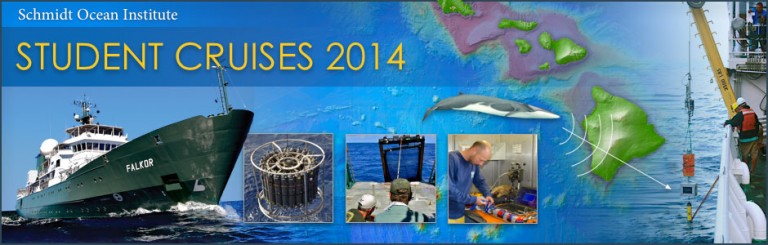
During the inaugural Schmidt Ocean Institute Symposium in November of 2013, Schmidt Ocean Institute (SOI) Vice President and Co-Founder Wendy Schmidt launched an initiative to inspire a deep passion for ocean sciences among students by bringing them out to conduct research at sea aboard the R/V Falkor.  At the time, SOI was already planning its collaborations … Continued
Person: Chang-Su Hong

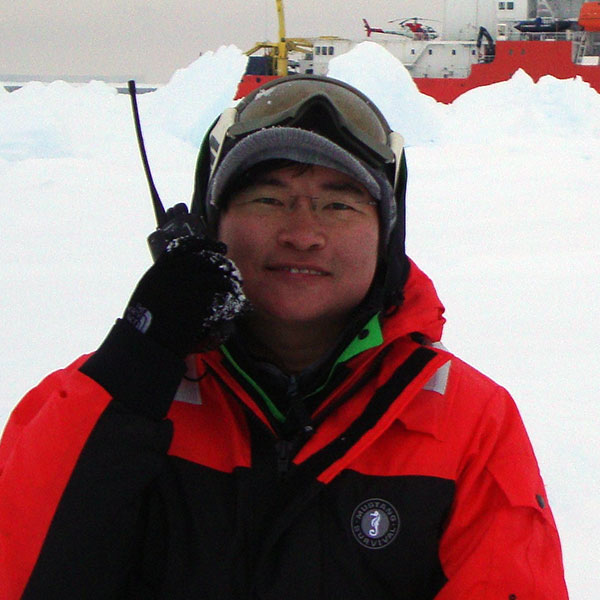
Chang-Su Hong is a research scientist for the Physical Oceanography Division at the Korea Institute of Ocean Science and Technology (KIOST). His primary responsibilities are field observation and basic data processing. He specializes in operating various instruments such as the microstructure profiler, CTD and ADCP. He has participated in many survey cruises in the western … Continued

Page: Previous Student Opportunities – by Cruise

Overview Application Process Apply Online Previous Student Opportunties Investigating Life Without Oxygen in the Tropical Pacific Eastern Tropical North Pacific, Hawaii to Tahiti — January 18, 2016 – February 11, 2016 Large-scale ocean circulation naturally results in low-oxygen areas of the ocean called oxygen minimum zones (OMZs). The cycling of carbon and nutrients – the foundation of marine life, called … Continued

Log Post: Converging on a Point

Science is a process of discovery. There is so much about the world that we do not know; discoveries can be made just about anywhere. Some scientists never have to leave the comforts of their own laboratory as their study subjects may be locally distributed, or they can access information from satellites and other data … Continued

Log Post: The Small Things that Count

And just like that, three weeks has come to an end. As the science team starts to pack up their equipment and explore the data collected, they get their first taste of the water profiles for this region. It seems like just yesterday we were leaving Majuro, Marshall Islands, to begin an 11-day time-series at the equator, but the time has gone by in the blink of an eye.

News: Schmidt Ocean Institute Advances R/V Falkor (too)’s Mapping Capabilities

Schmidt Ocean Institute reconstructs the bow of R/V Falkor (too), adds a high-performance Autonomous Underwater Vehicle (AUV) to its advanced technology suite, and reaches a major milestone: 2 million square kilometers of seafloor mapped to date. Video and photos available here. Palo Alto, California, USA — Schmidt Ocean Institute announces it has mapped 2 million … Continued

Person: Estefania Fernandez

Undergraduate student Estefanía is an assistant researcher at the Argentine Hydrographic Service (SHN) of the Argentine Navy. She is involved in projects that investigate harmful algal blooms and the Yaganes Marine Protected Area, located south of Tierra del Fuego Province, Argentina, using satellite data. Currently, as a Physical Oceanography student at the University of Buenos … Continued

Page: Vehicles Previously Supported

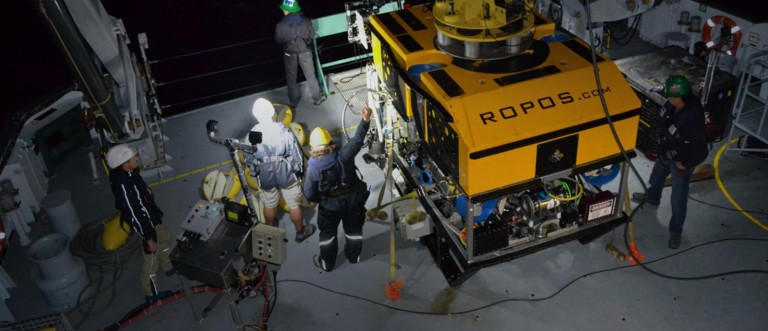
ROV SuBastian being launched off Falkor's aft deck via winch and A-frame. ROV SuBastian Developed by Schmidt Ocean Institute specifically to be operated off R/V Falkor,  ROV SuBastian is outfitted with a suite of sensors and scientific equipment to support scientific data and sample collection, as well as interactive research, experimentation, and technology development. Full … Continued

Log Post: Data Storytelling

In September of 2024, Artist-at-Sea Jill Pelto joined the Fire & Ice: Volcanic & Glacial Interaction expedition led by Dr. Sebastian Watt, University of Birmingham, UK. Pelto is an artist and science communicator based in Washington. She was intrigued by the opportunity to study the underwater effects of a 2008 volcanic eruption that dramatically transformed the landscape and lives of the people of Chaitén, Chile. 

Page: Schmidt Ocean Institute 2025 Expeditions

2025 – The Southern Atlantic In 2025, our scientific expeditions take us further into the Southern Atlantic Ocean, one of the least explored places on Earth. Scientists from all over the world will document biodiversity, study hazards such as earthquakes and volcanoes, and map seafloor features. Who knows what they will find? Follow our journey … Continued