Log Post: Mission Possible: Supercomputing at Sea

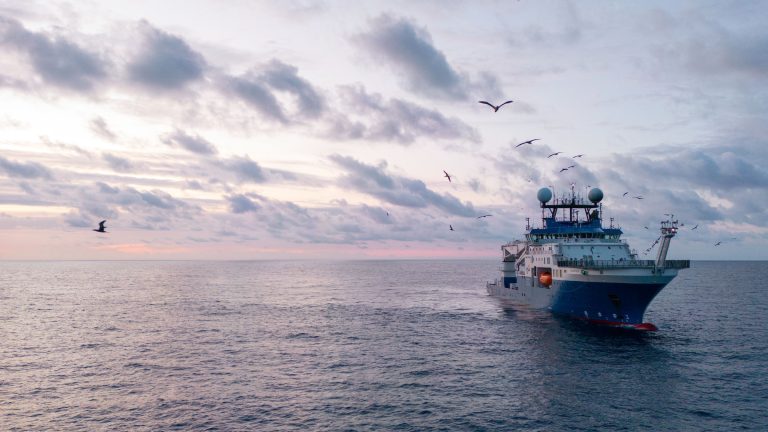
The 25-day Reef Connections expedition in the Timor Sea has just completed.  Its successful conclusion marks the third cruise this year to use Falkor’s high performance supercomputer. In January, Schmidt Ocean Institute installed a cluster of interconnected high-performance computers on board Falkor, making her the first research vessel with a supercomputing system available to scientists … Continued

Person: Sofia Ramalho

Sofia P. Ramalho is a Junior Researcher at the Department of Biology and Centre for Environmental and Marine Studies (CESAM) at the University of Aveiro (Portugal). Her research is focused on the study of the benthic diversity and ecosystem functioning in various deep-sea habitats (including cold seeps, submarine canyons and abyssal plains). She is also … Continued

Person: Claudia Morales

Claudia Morales Garrido is a master’s student in Oceanography at the University of Valparaíso and the Catholic University of Valparaíso, supervised by Dr. Manuel Castillo. At the same time, she is part of the Laboratory of Physical and Satellite Oceanography (LOFISAT) at the University of Valparaíso as a data analysis technician for oceanographic and satellite … Continued

Log Post: The choreography of science at sea

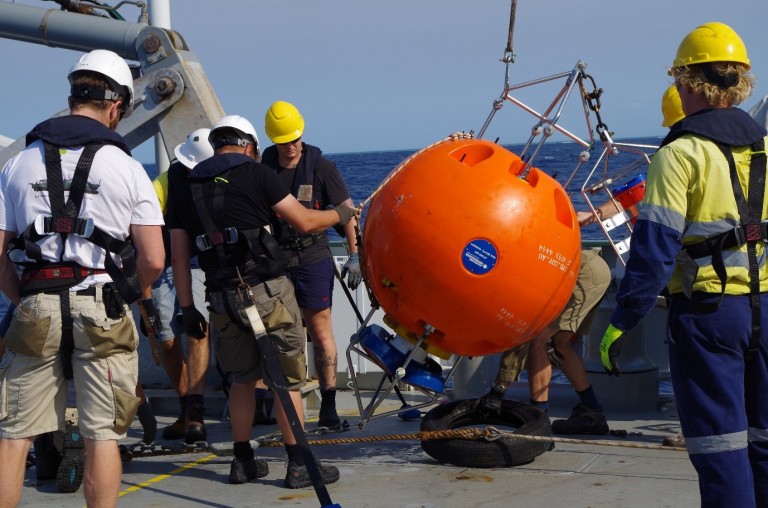
Science at sea is, above all else, a team effort. Scientific activities performed on Falkor require the ship’s crew and science party to work hand-in-glove; from ROV dives to CTD casts to work boat operations, every task is carefully choreographed to ensure objectives are met effectively, efficiently, and safely. And like a good dance routine, … Continued

Log Post: Curtains in the ocean: The “Turbo Team”

There are a number of ways to present or visualize oceanographic data. When an instrument like the CTD is lowered to the bottom, it provides an instantaneous picture of all the water properties at the drop site. Similarly, when we lower the turbulence probe (TurboMAP) it provides a picture of ocean turbulence properties over depth … Continued

Page: Schmidt Ocean Institute 2024 Expeditions

2024 – The Southeast Pacific The Southeast Pacific Basin, off South America, is one of the most tectonically active areas in the Pacific Ocean. The Peru-Chile Subduction Zone stirs off the continental shelf, where the Nazca tectonic plate dives under the South America plate, forming volcanoes and the 8000-meter-deep Peru-Chile trench. Wind patterns along the … Continued

Page: Partner & Grantee Spotlight – Chapter 5, 2023

Ocean Rising Brings High Fashion to Sea Ocean Rising is an initiative of SOI and Nekton to deepen people’s relationship with the Ocean by galvanizing connections and tangible initiatives within significant sections of global culture from the arts, fashion, sport, music, gaming, film, literature, and food amongst others. Ocean Rising is currently focused on music … Continued

Log Post: Feeding the reef

Today we start mapping the pathway between the surrounding ocean and the amazing coral population of the Scott Reef system. Due to the lack of rainfall and strong heating in the region, the ocean has a very strong vertical temperature gradient – as much as 30 °C at the surface, and then colder as you … Continued

Log Post: The Presence of Microplastics

At last, the day we’ve been waiting for is here! After what felt like forever of planning this cruise, today we finally departed from Balboa, Panama. The excitement is real, and I cannot wait to see what this journey has in store for us. I am part of the team from Aalborg University, and we … Continued

Log Post: Ocean drivers of reef productivity

Coral reefs are among the most productive ecosystems on the planet, with the primary producers at the base of the food chain (including corals) supporting their complex food webs. Through primary production, reef organisms covert carbon dioxide via photosynthesis into energy (organic carbon) that they and other reef organisms use for food. Although light provides … Continued