Cruise: Expanding Mariana Trench Perspectives
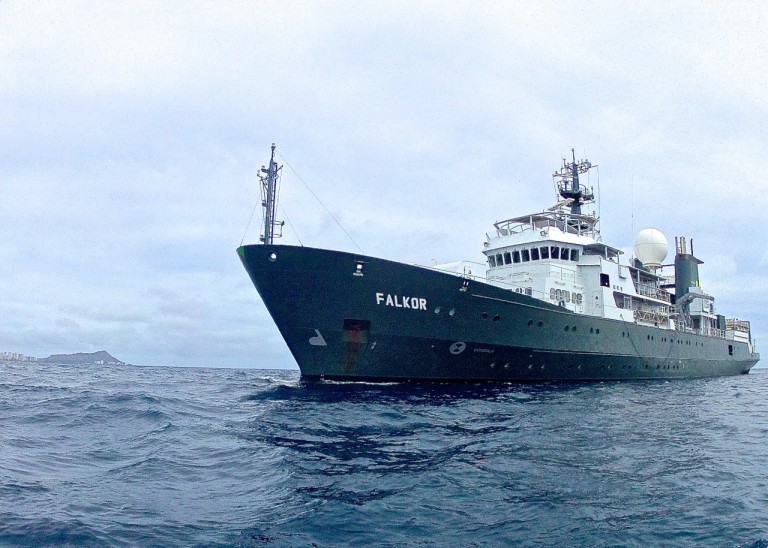
December, Falkor returned to the Mariana Trench focusing on collecting trench bacteria, animal samples, and the first-ever recordings of sounds from such depths.
Search Results for
December, Falkor returned to the Mariana Trench focusing on collecting trench bacteria, animal samples, and the first-ever recordings of sounds from such depths.
The first ever comprehensive study of the largest, most focused internal tide on the planet, which moves across the Tasman Sea each day. During this expedition, researchers will amass data that will improve general understanding of the phenomenon, as well as the ability to incorporate internal tide effects accurately in climate models.
Perth Canyon is one of Australia’s subsea treasures. Yet many of its deeper reaches remained unexplored, until Falkor’s visit with a deep-diving ROV. This first survey of life in the canyon provided a baseline of deep corals, which will aid in determining the likely future impacts of warming seas and ocean acidification.
At the end of March, Falkor headed to a spectacular, isolated, coral wonder known as Scott Reef. The goals of this project were to improve techniques and algorithms for efficiently coordinating deployments of multiple exploratory vehicles so they can be left unattended to accomplish tasks like detailed seafloor mapping.
The Timor Sea expedition explored factors that affect the health of remote coral reefs and the connections between reefs. This collaborative project expands on previous research at shallower reefs, and encompasses the first ever exploration of deeper sites.
In the past decade the world has been repeatedly reminded that tsunamis are one of the most destructive forces on the planet. In May, Falkor took a team of geophysicists to Indonesia for an unprecedented expedition designed to clarify the mechanisms that cause tsunamis, and help millions to better prepare for a tsunami.
In search of an asteroid that ended the Cretaceous Period.
In June of 2013, R/V Falkor will be using the hybrid underwater robotic vehicle Nereus, to explore the depths of the Mid-Cayman Rise, which reaches more than 6,500 meters (~4 miles)
The Falkor team has completed the first-ever high-resolution map of deep reefs near the island of Roatan in Honduras.
Using a combination of bathymetric mapping and magnetic readings, scientists hope to explain how the world’s largest volcano was built.